

Europe's total solar capacity has crossed 406 GW. Most of that capacity is controllable: utility-scale plants typically come with hardware controllers and gateways that enable the generation to be flexibile.
But a growing share of it is not. Tens of gigawatts of small-scale residential and C&I solar, rooftop systems on homes, warehouses, schools, and small factories, produce at full output whenever the sun shines, with no way for anyone to intervene.
Spain alone has roughly 10 GW of self-consumption solar capacity with close to zero controllability. That fleet is expected to double by 2030. The Netherlands curtailed 709 GWh of renewables in 2025 alone. And in Spain, curtailment reached a record 11% during summer 2025.
The problem is specifically uncontrollable solar. And the challenge is concentrating in the segment that's hardest to reach: distributed plants between 5 kW and 500 kW, spread across thousands of sites, owned by thousands of different operators.
The hidden cost of doing nothing
If you own solar plants or buy their electricity, you've already noticed this problem. Solar panels all generate at the same time at midday, which floods the market with electricity and drives prices down, sometimes below zero. This means solar owners end up selling their power at exactly the wrong moment, earning far less per unit than the daily average price. And if they can't simply switch off their panels during those low-price hours, they're stuck selling into a market that doesn't want the electricity.
Consider a utility with an 800 megawatt-peak distributed solar fleet where 57% of production goes to self-consumption: the remaining export, sold into solar-hour price troughs, can represent a capture rate gap of €30+/MWh compared to baseload. Across a portfolio of that size, that's a multimillion-euro annual drag, revenue that's structurally lost because the assets can't respond to price or grid signals.
Regulations are also tightening. The Netherlands has confirmed the full phase-out of net metering by 2027, explicitly to curb uncontrolled solar feed-in. Switzerland's new Electricity Act now mandates smart control for all solar above 10 kW, and grid operator interventions have quadrupled since 2018. The direction is clear: assets that can't be curtailed will increasingly face regulatory constraints, grid access limits, or outright penalties.
For anyone sitting on a fleet of legacy C&I or residential PV installations, the question is no longer whether they need curtailment capability. It's how to add it at a cost that makes sense.
Why hardware hasn't solved this fully
The reason so many small-scale solar assets remain inflexible comes down to unit economics.
At utility scale, the hardware model works, such as coupling solar with batteries. For a 15 kW residential rooftop or a 200 kW warehouse installation, the hardware proposition breaks. Why?
Making these sites controllable the traditional way requires some combination of on-site control hardware, technician site visits, per-site communication infrastructure, and ongoing maintenance. The per-site cost of this stack is rather high, and you still have to account for the logistics of coordinating installations across dozens or hundreds of sites, each with a different inverter brand, different site access requirements, a different asset owner to schedule, and with deployment timelines stretching to months.
Adding batteries doesn't close the gap either. Batteries can shift excess midday production to more valuable hours, but they follow the same economics: storage costs spread more cost-efficiently over more kWh, so pairing PV with storage is viable at utility scale. For most residential and C&I sites, a battery is an expensive answer to what is fundamentally a control problem.
Cloud-to-cloud control and aggregationsl: the cost equation that finally works
Cloud-to-cloud solar control changes the equation by removing the hardware layer entirely. Instead of installing control equipment at every site, an aggregator, like Synergi, connects directly to the inverter manufacturer's cloud API — the same interface the asset owner already uses to monitor their system.
This is the approach Synergi has built into its technical aggregation platform. We connect to inverters from major OEM brands through their existing cloud infrastructure. Once connected, each inverter becomes a controllable node in an aggregated fleet that can be dispatched as a single unit.
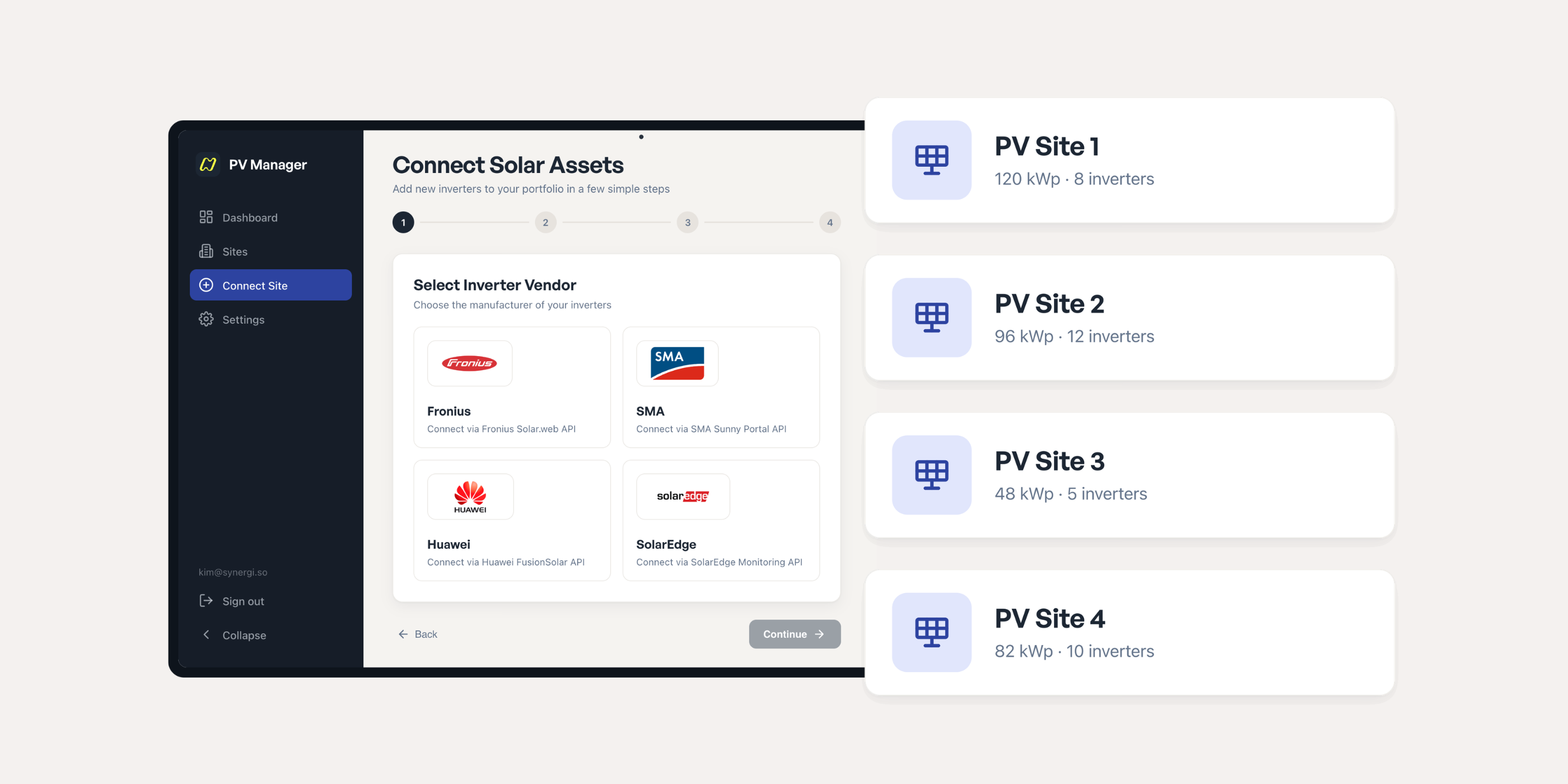
What this looks like in practice: An asset owner onboards solar installations through the Synergi PV Manager. Connection takes minutes: the asset owner authenticates through their existing inverter portal, and the system is live. From that point, Synergi's platform provides fleet-wide production monitoring, telemetry, and fault visibility, along with the ability to send real-time curtailment signals to individual inverters or the entire fleet with sub-10-second latency.
For trading desks and grid operators, this translates to dispatchable solar capacity through Synergi's External API: baseline load forecasting, activation signals hours to minutes before delivery, and per-asset reporting. Use it for negative price avoidance, congestion management, or imbalance reduction. In markets where curtailment qualifies as a flexibility product, pool the capacity and bid it into reserve markets directly.
Proven in production, not just in theory
Synergi's cloud-to-cloud aggregation is already operating in production environments.
In Finland, Synergi runs a +10 MW cloud-connected VPP of residential EVs, with 2,000+ weekly active vehicles qualified for mFRR and local congestion markets. The same architecture, cloud API connections, real-time dispatch, and market-grade activation, now extends to solar PV.
In Switzerland, Synergi is working with leading utilties on solar curtailment for both residential and C&I installations, with successful curtailment executed at sub-10-second latency via Fronius and SMA cloud integrations. The External API enables trading desks to trigger activations directly, validating the full end-to-end flow from cloud connection to market-ready flexibility.
Both residential rooftops (5–20 kW) and C&I installations (20–500 kW) run on the same platform. Whether you're a DSO managing local congestion, a utility optimising procurement, or a trader adding dispatchable solar capacity to your book, the aggregation layer handles the diversity of inverter brands, installation sizes, and contractual arrangements behind a single API.
The window is now
Europe's uncontrollable solar fleet is doubling this decade. Curtailment requirements are tightening. Capture rates are compressing. Every quarter you wait, the economic drag from uncontrolled feed-in compounds and the regulatory risk grows.
The barrier was always cost. Cloud-based aggregation removes it. If you operate a C&I solar portfolio, manage a utility PV programme, or run a trading desk with growing solar imbalance exposure, the assets you need to control are already connected to the cloud. They just need to be activated.
Get in touch to discuss a pilot, or start with a proof of concept on a handful of devices to see the results firsthand.
Related reading:
- Demand-side flexibility for utilities: how to aggregate DERs into market-ready pools
- Synergi joins Swissolar: residential and C&I flexibility for Switzerland's solar future
- Synergi and Väre partner to bring household flexibility into the core of electricity retail
- How Synergi launched its VPP and brought cloud-connected EVs to the mFRR market
- How Helen develops flexibility solutions for households with Synergi


.png)
%20(1).png)
.png)
.png)

.png)
.png)

