

When Synergi set out to build VPP software for utility companies, we knew we had to operate a VPP ourselves first. So we built one on top of our consumer application, brought residential EVs into Fingrid's mFRR reserves, and became Finland's first residential EV aggregator in the market. The goal was not to become an energy trader. It was to develop the technology and operational expertise that utility companies, DSOs, and asset managers would eventually need from us.
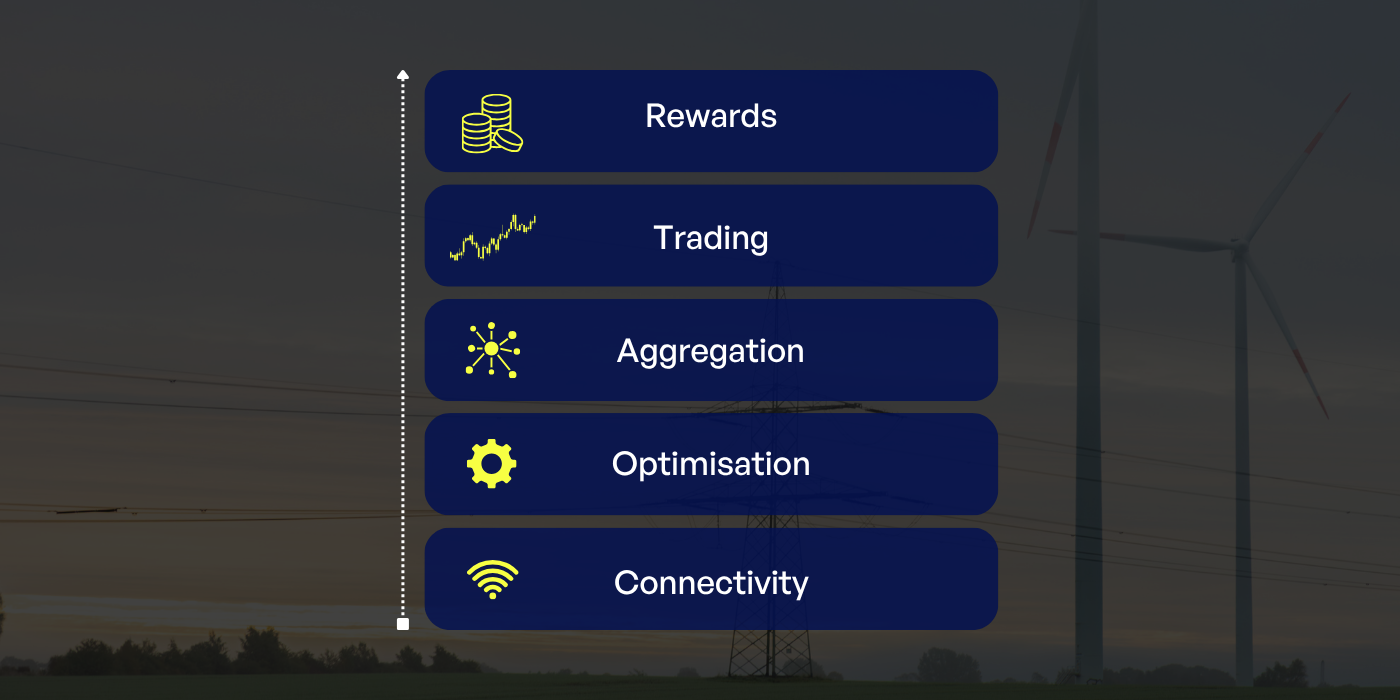
A VPP is made up of distinct layers of technology and operations working together. If you remove any one of them, the system either cannot participate in the market or cannot sustain participation over time.
This blog breaks the layers apart so that anyone evaluating a VPP strategy for residential and C&I assets can see what is required:
Layer 1: Connectivity
The first question anyone evaluating a VPP strategy asks is how to get their existing fleet online.
For instance, Synergi’s offering and approach is to handle asset connectivity entirely cloud-to-cloud, without a single piece of hardware. Synergi has integrations with over 400 OEM brands across EVs, heat pumps, solar, and batteries
Because the integration is software-only, if you partner with us, your VPP can combine mixed brands and sizes across multiple sites and countries. Software-only is also gaining traction across Europe, especially in the residential and C&I solar segments where retrofitting small assets with hardware is too expensive.
It all starts with connecting devices to an interface, which lets you build an aggregated portfolio. Synergi provides both layers: the connectivity underneath and the user/customer interface on top, either white-labelled or Synergi-branded.
For a VPP, connectivity is not just about the breadth of device support. It is about response reliability. Each manufacturer's cloud API behaves differently: some brands acknowledge commands in seconds, others take significantly longer. That latency directly affects how much capacity you can bid into a given market. Knowing which devices respond fast enough, and building that into your portfolio sizing, is what turns a list of connected devices into tradable capacity.
Layer 2: Optimisation
Connected devices need intelligence to be useful. Synergi’s optimisation layer decides when to charge, when to pause, when to heat or cool, when to curtail, and how to schedule each device based on a stack of inputs such as electricity tariffs or grid commands. Optimisation is also critical if you are planning to run a residential VPP, because consumers need meaningful optimisation benefits for their own devices. In fact, previous pilots have shown that one of the main motivations for consumers to join demand response programs is the value they get from energy optimisation.
In Finland's mFRR market, where we run our own EV VPP, the optimisation challenge is unique. The system has to determine how much controllable capacity the portfolio can genuinely offer in each hour of the upcoming delivery period. User behaviour and seasonality are constant variables here, producing different usage habits and different flexibility availability from one hour, day, or season to the next. This is also why, as we explain later, the rewards layer is what ultimately decides whether residential customers stay enrolled long enough for that capacity to be dependable.
Optimisation is also broader than demand shifting. Another is reserving capacity: instead of manipulating consumption so it can be bid into ancillary services. This matters most where consumers are not on dynamic tariffs. Without a market signal to react to, households charge on their normal schedule, usually in the evening, and that predictable consumption is exactly what can be committed to ancillary services and demand response. Here optimisation is not about adjusting when people consume, but about reserving and orchestrating their existing consumption into dependable, dispatchable capacity.
Layer 3: Aggregation
Individual device control is necessary but not sufficient for market participation. Reserve markets like mFRR operate in megawatt-scale increments with specific technical requirements: minimum bid quantities, activation response times, baseline methodologies, and pre-qualification processes.
Synergi’s aggregation layer pools individual devices into a single portfolio that can meet these requirements. It handles the mapping between what the market expects (a block of controllable capacity at a specific price for a specific delivery period) and what the portfolio actually contains (hundreds or thousands of individual devices, each with its own availability probability and response profile).
For a trading desk, this is the layer that matters most. Aggregation bundles the connected assets into a single aggregated signal, a sub-pool that a larger VPP or trading system can treat as one controllable resource. Synergi's pooling is rule-based and fully configurable through an External API: pools are composed and recomposed on demand by asset type, region, balancing group, contract, or any custom tag, so the fleet can be carved to match exactly how it is traded.
Layer 4: Dispatch
Dispatch is where the VPP engine meets the market signal. Synergi does not trade on a customer’s behalf. Bidding, positions, and market strategy stay with your trading desk or DSO control system. What Synergi provides is the engine that turns a market instruction into physical response across thousands of assets.
When a commitment needs to be delivered, the VPP engine dispatches control signals to the committed assets, pausing or shifting EV charging sessions, curtailing solar, or adjusting heat pumps to match the committed volume.
Synergi's engine responds with grid-ready latencies, controlling the full portfolio as a single flexible resource via API/MQTT. During an active dispatch window the engine increases its polling cadence so telemetry and control both run at the required latencies.
Layer 5: Rewards
In a VPP composed of residential assets, every device in the portfolio belongs to a person, in it for the optimisation benefits and also rewards.
For that reason, when we built our EV-VPP, we had to build a rewards logic and ecosystem that could sustain participation over time. Our rewards engine compensates participants for their availability, that is for staying plugged in as long as possible, they earn points, exchangeable for rewards. This mechanic allows Synergi to count on the required loads to participate in the mFRR market whenever needed.
For utilities exploring residential flexibility, the rewards ecosystem is increasingly relevant as a product in its own right. The utilities we speak with already have trading desks and market access. What they often lack is the consumer-facing infrastructure that recruits households, keeps them engaged, and translates grid-level value into individual compensation.
Why the layers matter together
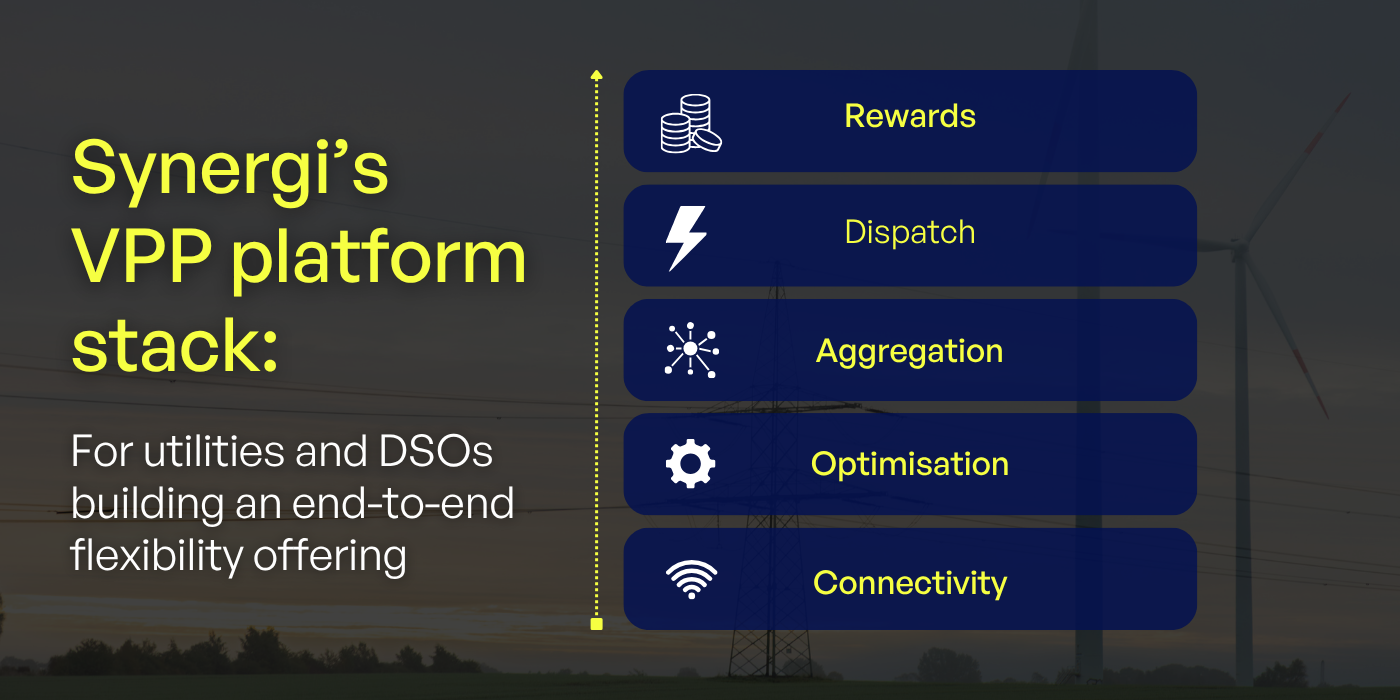
Some vendors sell only device connectivity, with no way to aggregate or dispatch them; others will sell the connectivity, aggregation, or dispatch, but no rewards engine to sustain consumer participation over time. The value of Synergi’s VPP engine is in the complete stack: devices connected, behaviour optimised, portfolio aggregated, capacity dispatched, consumers rewarded.
Synergi built every layer in a live Finnish market, operating daily in Fingrid's mFRR reserves. That end-to-end experience is what utility partners now access when they work with us, whether they adopt the full platform or integrate specific layers into their existing stack through our External API.
If you are evaluating how to build residential flexibility into your residential and C&I portfolio, get in touch via the form below. We can walk you through each layer and how it fits your plans.


.png)
%20(1).png)
.png)
.png)

.png)
.png)
.png)

