

.png)
During the last decade, the EU has been in a race to decarbonise how we produce and consume electricity, especially in the transport sector. In just a handful of years, this push drove a surge in electric vehicle adoption across multiple European nations. Between March 2025 and March 2026, new EV registrations in Europe grew by about 50 percent. On the surface, growth like this is always impressive — but look deeper, and you realise that if it weren't for what electric vehicles now enable, they would be putting more strain on the grid than they relieve.
For many years, in fact, EVs were considered "uncontrolled loads." Today, they are treated as flexible energy assets, thanks to the development of OEM cloud services and the large ecosystem of players that has grown on top of them. That ecosystem now supports services such as smart charging, shifting charging to cheaper, less congested hours for the grid, and most recently, virtual power plants that aggregate thousands of cars into a single flexible load to support the grid.
Why hasn't the same thing happened with small-scale solar?
Europe sits on a vast base of solar PV that remains inflexible
Solar PV has grown rapidly in Europe, but the last couple of years have seen the market turn. 2025 marked the first decline in the EU solar market in a decade. On current trends, the EU is now projected to reach only 718 GW of installed solar by 2030, falling short of the 750 GW target. SolarPower Europe anticipates two more years of market decline ahead.
The slowdown in new installations is closely tied to the difficulty of integrating variable renewable generation into power mixes. Rising curtailment, the challenge of absorbing solar onto the grid, and the weaker financials of new projects have all played a part. As a result, regulation is tightening too. The Netherlands confirmed the full phase-out of net metering by 2027, explicitly to curb uncontrolled solar feed-in, and Germany’s Energy Industry Act, paragraph 14, mandates remote control for residential assets above 4.2 kW.
The point is that massive amounts of solar have already been deployed across European rooftops. So the question is: how do we make the most of the solar that already exists? As experts have pointed out, turning existing inflexible solar assets into flexible ones is key. Without rapid deployment of solutions such as smart control, demand response, battery storage, and grid digitalisation and expansion, solar's value will remain constrained, driving even lower adoption in the future and undermining its potential as a key technology to help Europe become the world's first climate-neutral continent by 2050.
Most of Europe’s residential and C&I sites can’t be controlled only with hardware
Making existing solar flexible sounds easy enough and technically, it can be. Solar inverters aren't so different from EVs: they have clouds and APIs giving remote control possibilities. Yet this same flexibility logic that transformed the EV industry has barely reached the solar industry. Instead, storage is the default whenever solar PV comes up.
For utility-scale projects, storage makes the most sense. But what about residential and C&I? Because storage costs spread more efficiently the more kWh you have, coupling utility-scale PV with storage is significantly cheaper than doing the same in the residential and C&I segments. Research shows battery attachment rates for C&I solar remain below 5% across the EU. That's no coincidence: for most residential and C&I owners, pairing their own solar with batteries at smaller scale simply doesn't make financial sense yet.
So what other options are there? With a considerable share of Europe's solar power already wasted in 2026, the signal is clear: something isn't working. With flexibility solutions still barely paired with solar, one question remains: how do we make as much of today's solar capacity flexible as possible? For anyone sitting on a fleet of legacy C&I or residential PV installations, the question is no longer whether they need flexibility solutions. It's how to add it at a cost that makes sense.
Software alone could be the missing piece that makes Europe’s solar flexible
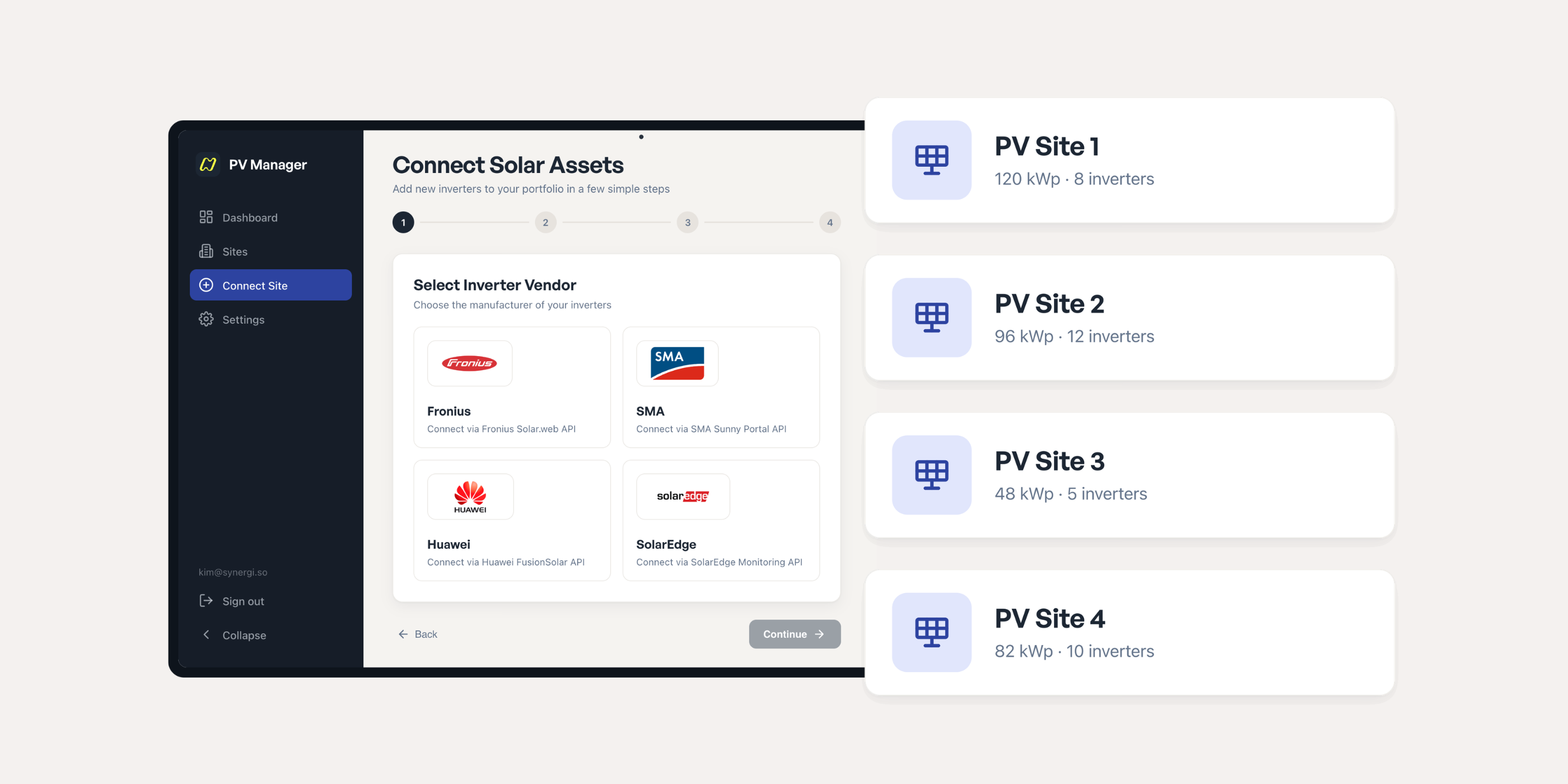
Just as cloud-to-cloud EV optimisation and aggregation made residential EV VPPs possible, software-only solar control and aggregation can give homeowners and solar asset managers the control they need, without hardware or on-site installations.
What's notable is that this is already mandated in some countries but rest of Europe is still waiting to follow suit. Germany, as mentioned, requires remote control for solar assets above certain sizes. Research also shows that curtailment can be reduced, and shared more fairly among PV owners, by centrally coordinating the operation of PV inverters.
The case for software is that it can scale rapidly across distributed PV portfolios, spanning multiple sites and OEM brands. The open question is whether Europe's energy players are willing to broaden their approach to solar flexibility — so far, the conversation continues to centre on storage, even though no convincing financial case for storage has yet emerged at residential and C&I scale.
There’s a financial upside, too. In Iberia, for instance, Aurora Energy Research estimated that solar assets could earn up to 35% in the 2020s by participating in ancillary services and intraday markets. Therefore, aggregating solar into a single, controllable unit is not only about meeting regulations but also about making it a key part of Europe’s energy flexibility and providing a valuable return on investment for various energy players.
Across Europe, EVs, heat pumps, and batteries are already being aggregated into virtual power plants that trade in and help balance the grid. Solar PV shouldn't be the exception: the same VPP capabilities belong to every solar asset, and the technology to deliver them exists today.


.png)
%20(1).png)
.png)
.png)

.png)
.png)

