

.png)
TL;DR: Utilities, DSOs and asset managers all struggle with the same question: What is the right interface to start building a flexibility program or VPP for residential and C&I use cases? There are various options such as building on top of an existing app, building one from scratch, licensing a white-labelled app, launching on a ready-made partner app, or exploring the web app route for C&I portfolios. None is universally correct. The right choice depends on factors such as how fast you want to go live, what assets you're planning to onboard and what segment, and how much you are willing to invest upfront before you have proof that your choice will work.
Below is a table on how the five options compare:
The options in detail
Energy companies planning a flex program or VPP all run into the same question sooner or later. What interface should end-users or asset managers use? The interface is where end-users or sites (think C&I portfolios) connect and follow what is happening in their devices or asset portfolio, allowing you to control and activate those assets in various ways.
As a company building flexibility technology for utilities, asset managers, and DSOs, this is one of the most common questions we get. The honest answer is that there is no right or wrong option. The right choice depends on some factors. How quickly do you want to start building flexibility, what assets you're planning to onboard and what segment, and how much are you willing to invest before you have proof that your route will work?
Most flexibility programs or VPPs choose between the follow interface models:
- Existing app: Energy retailers usually have their own consumer app. Keeping everything under one interface your customers already know is a valid strategy. In this model you can integrate specific capabilities from a technology provider into your own app through APIs. The main benefit is that you own the customer experience end to end, and your customers don’t need a new app or login, so adoption friction is low. The downside is that since the original app was not built with running a flexibility program in mind, it can become a crowded or confusing experience for customers who are not ready to participate. The integration also takes your own development time and budget, which makes go-live slower than other routes.
- New app from scratch: You can also commission a new app for your flex program or VPP. The main benefit is total control. But, arriving at this solution means you know exactly what to build. Building your own app means building the logic behind it, such as how you will reward customers, how the device optimisation features will work, or what the connectivity strategy will be; fully in-house device integrations or via API providers? Technology providers offer such capabilities as standalone, but even then, you need to evaluate from multiple partners to find out which one fulfils your requirements. Committing to all this before flex demand is validated, is the riskiest version to invest in upfront.
- A white-labelled app: With a ready-made application delivered under your brand, you get your own app for your flexibility program without building or maintaining it in-house, and you can add the capabilities or integrations that make sense. Device connectivity, optimisation, aggregation and rewards work from day one and are kept up to date by the provider. The trade-off is that licensing carries upfront and recurring costs, which is still a risk to consider before the use-case is validated. A new app also starts with zero installs, so user acquisition is mostly on you, and customisation is limited to what the provider's platform supports.
- A ready-made partner app: You can launch a program on an application that already exists. Synergi, for example, runs a consumer app with all the required layers to test a flexibility program or virtual power plant (VPP) and user recruitment mechanics that partners can use for their own schemes. This is the most affordable option and the easiest way to test flexibility with a subset of customers. The trade-off is limited branding, and your customers operate in an environment that is not your own. However, in our own pilots with leading utilities, consumer feedback demonstrated there was zero distrust towards a third-party operator running a flexibility program on the Synergi app environment. On the contrary, consumers rated the experience high and continued to use the service.
- A web app: For other flexibility use cases beyond the residential route, such as the C&I PV segment, a web app can be a natural place to onboard and manage assets. Asset managers and trading desks at utilities do it only once per fleet. It makes onboarding and visualising a whole portfolio easy, and it is simple to white-label under your company's brand. The trade-off is scope. A web app serves asset and portfolio management, so it does not answer the consumer engagement side of a flex program on its own because consumers want convenience (which they already have in their pockets) and need to be close to their devices.
Each of these options is used in real flex deployments today and there is no single correct option. Our role at Synergi is to help clarify a path by walking you through the options.
The real question is speed versus upfront investment
When making the decision, the most critical questions energy companies have to evaluate are: how much to build in-house, how much to spend before seeing results, and how fast are you willing to get your first learnings?
We understand why some energy companies may want to keep end-users within their own brand environment, whether by sticking to their own apps or buying a white-label app. But in many cases, this direction can be costly and risky, especially if the company had no idea what you build because they have no idea what consumers need. Some utilities are comfortable taking this approach and trying it out is part of the learning curve.
Many utilities are in a different position. They want to know whether flexibility creates value for their customers and their business before making a major investment. For them, the fastest route to an answer is to pilot on an interface that already exists.
Starting with an existing app gets you learnings fastest
The Synergi app connects to more than 400 device brands, from EVs, heat pumps and solar inverters, in under two minutes with no hardware installations. For consumer programs, the user acquisition and rewards mechanics have been tested with thousands of households. That means a utility can start onboarding a subset of its customers and testing flexibility without building anything first.
A pilot on an existing app answers the questions that actually matter for your program design: which customers opt in, which devices they bring, how they respond to control events, what rewards keep them engaged, and what the aggregated flexibility is worth in your market.
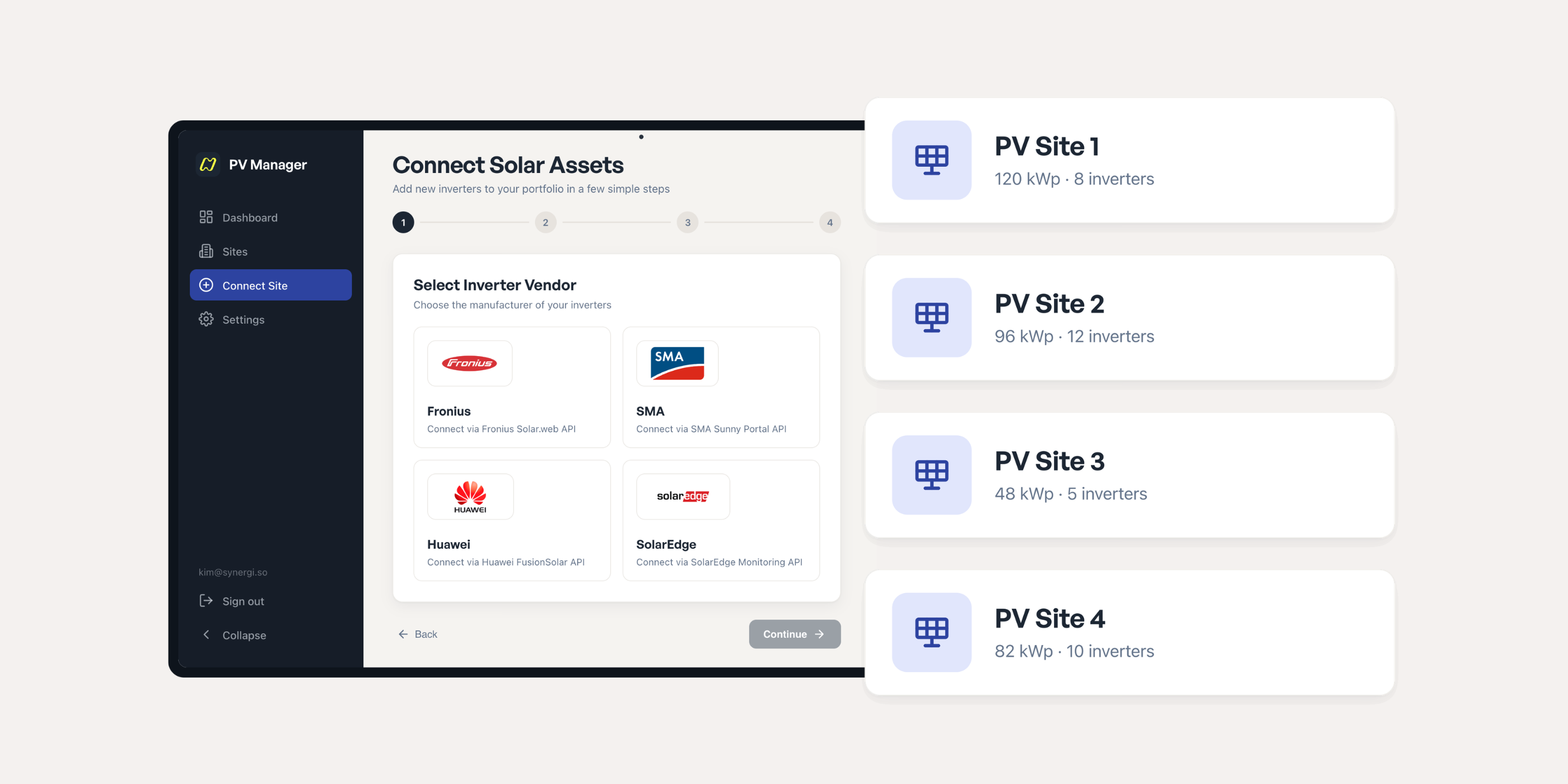
On the C&I side, our product, PV Manager, already allows utilities and asset managers to onboard assets to a web app under their own brand, connect via cloud connections and Synergi’s VPP engine, and aggregate and pre-pool those assets via API/MQTT as a single signal to their trading desk or DSO control system.
.png)
You are not locked in after a pilot
Starting on the Synergi app for the residential route is not final, and it does not mean giving up on your own interface ambitions. It is a first step, and the pilot learnings tell you which second step is worth taking. From there, partners can continue in three ways.
Some continue scaling on the Synergi app, like Helen, because it works and their customers are happy with it.
Some continue to a white-labelled versions once the concept is validated. Others select specific modules from Synergi’s VPP platform, such as aggregation and control through our External API.
So which one is right for you?
If you have a strong existing app and in-house development resources, integrating flex modules through an API keeps your customers in one interface you control. But, if you have evaluated that your strategy requires your own app but you do not want to build and maintain one in-house, a white-label is a good option. If you want to test the value of flex with a subset of users or assets quickly and keep upfront spend low, start with a partner app and decide the rest after the pilot. If your pressing need is on managing and aggregating C&I assets without needing any on-site hardware, then a ready-made tool, like PV Manager, is worth exploring further.
Want to scope what a flex pilot could look like for your customers or PV portfolio? Contact us below:


.png)
%20(1).png)
.png)
.png)

.png)
.png)

