

.png)
The most pressing problem with solar power in Europe right now is that panels generate in the same midday hours, pushing day-ahead prices down and increasingly below zero. For a trading desk, midday solar is a cost you absorb on uncontrolled feed-in and a flexibility revenue line you cannot yet reach: you cannot trade what you cannot control.
Common solutions so far have been to install batteries or other hardware to make PV solar flexible, but what if the hardware route is too costly — especially when you have to retrofit thousands of small plants (between 5 and 200 kW) across a dozen inverter brands?
Synergi’s cloud-to-cloud aggregation and control (PV Manager) is the solution that makes economic sense: by connecting at the inverter manufacturer's cloud, an aggregation layer can control your whole portfolio of residential and C&I assets as a single flexible resource.
With PV Manager you connect inverters through their OEM clouds, pre-pool them on Synergi's VPP engine, and then read telemetry and dispatch the whole pool from your trading desk or control system over a single API. PV Manager is the asset, pooling and dispatch layer beneath your central control platform.
The sections below follow the way you, as a trading desk operator, would assess PV Manager, giving you a clear view of how it fits your current stack:
.png)
Asset connectivity & onboarding
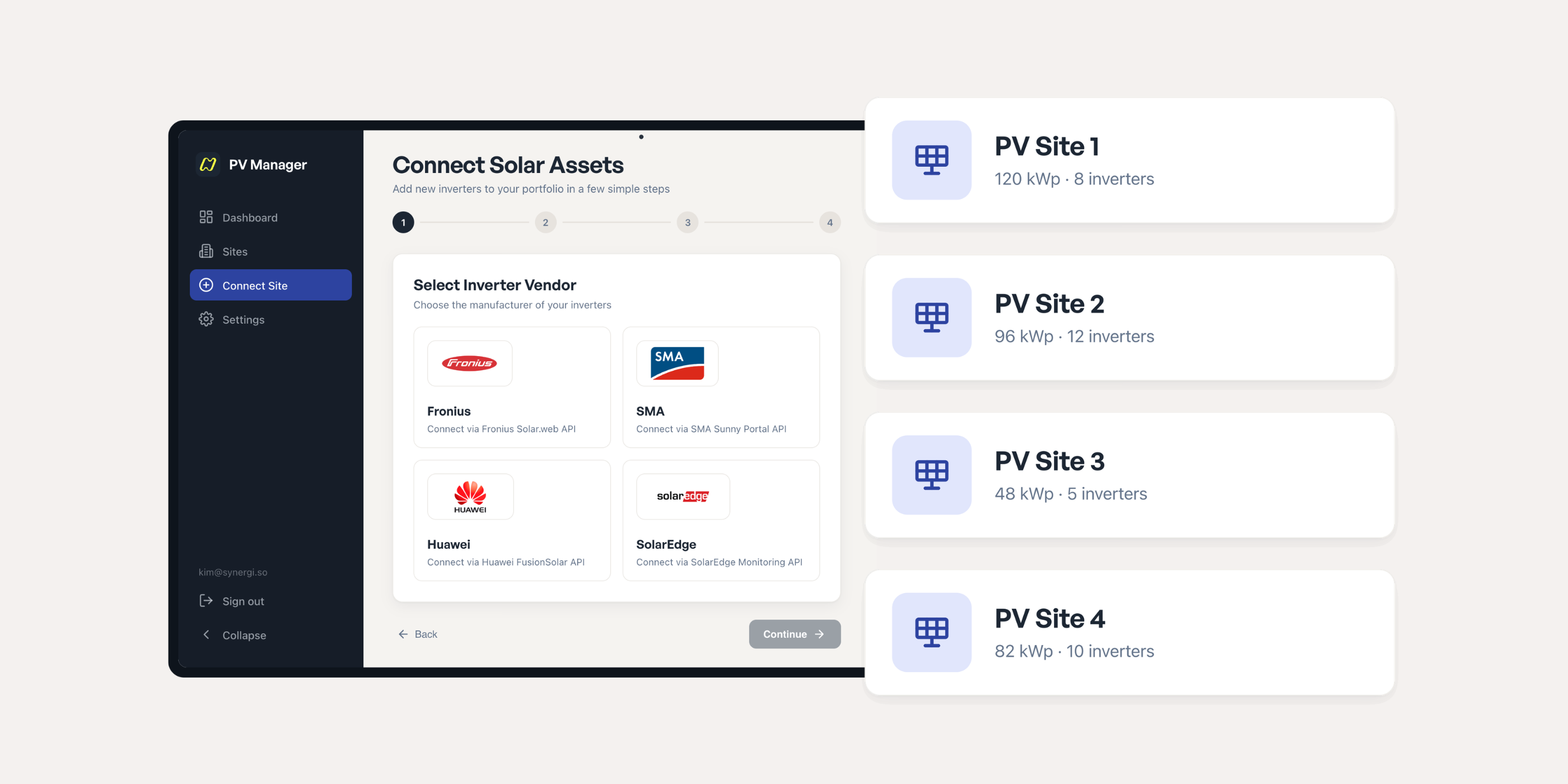
PV Manager connects distributed solar inverters across both segments that defeat hardware economics: residential systems and C&I systems. Four OEMs are supported in production — Fronius, SMA, Huawei, and SolarEdge — connected directly through their cloud platforms. Further OEM integrations are in active development.
Every integration is purely cloud-controlled via the OEM API. The same OEM connection reads metering, status and availability data and writes control commands, so a mixed-brand fleet behaves as one unit once connected.
Asset owners connect plants through the PV Manager web application (Synergi-branded or white-labelled) using their OEM portal credentials and a one-time consent grant.
Pre-pooling solar into a sub-VPP
PV Manager's core function for a trading desk is aggregation: it bundles the connected plants into a solar sub-VPP — a single aggregated signal that your larger VPP treats as one controllable resource, with live production, status and capacity visibility across every site behind it.
Pooling is rule-based and fully configurable through our External API. Pools are composed and recomposed on demand by asset type, region, balancing group, contract or any custom tag, so you can carve the fleet to match how you trade it.
Control, dispatch and latency
PV Manager dispatches the aggregated fleet as a single unit: on/off curtailment, gradual (active-power / export-limit) curtailment, and ramp-up, used for automatic curtailment through negative-price or surplus windows and for reserve- or balancing-market response. Control depth varies by OEM.
On latency, what matters to a desk is responsiveness when a pool is live. During an active dispatch window PV Manager increases its polling cadence so the fleet operates at under one minute latency, both for telemetry and for control.
Built for and with European utilities
PV Manager was developed alongside European partners. BKW in Switzerland was among the earliest design partners, contributing requirements across multi-brand fleet management, emergency curtailment and trading-system integration. Solar asset manager Youdera helped shape the C&I fleet side.
If you want to add solar to your flexibility book without a hardware programme, book a 30-minute demo to see how PV Manager and the External API work with your fleet:


.png)
%20(1).png)
.png)
.png)

.png)
.png)

